
Social Anxiety vs Generalised Anxiety: Understanding the Overlap and Differences

Updated: Apr 30
Guest Post by Sophia Spencer

When people talk about anxiety, they often use the term broadly.
However, Social Anxiety Disorder (SAD) and Generalised Anxiety Disorder (GAD) are distinct conditions [1], even though they share some common ground.
Often, this can lead to misdiagnosis or confusion. Let’s take a look at where they meet and where they differ.
The Common Ground
Both SAD and GAD share some fundamental features [2, 3]:
Fear:

Both conditions are based on worrying and fear about what could happen and what has happened.
Both conditions include worrying.
Both conditions often involve developing a range of behaviours to try to cope with the anxiety.
Both conditions often involve feelings of anxiety and physical symptoms such as heart palpitations, nausea, shaking, tension, and more…
Uncertainty:
One of the central key similarities is a dislike for uncertainty. Uncertainty feels scary and something to try to prepare for.
Reading this, you might be thinking ok, so they’re the same?
And in some ways, the answer is yes. They are the same when it comes to the anxiety process described above.
However, their focus and underlying fear of what might happen, and why, is often different.
Key Differences
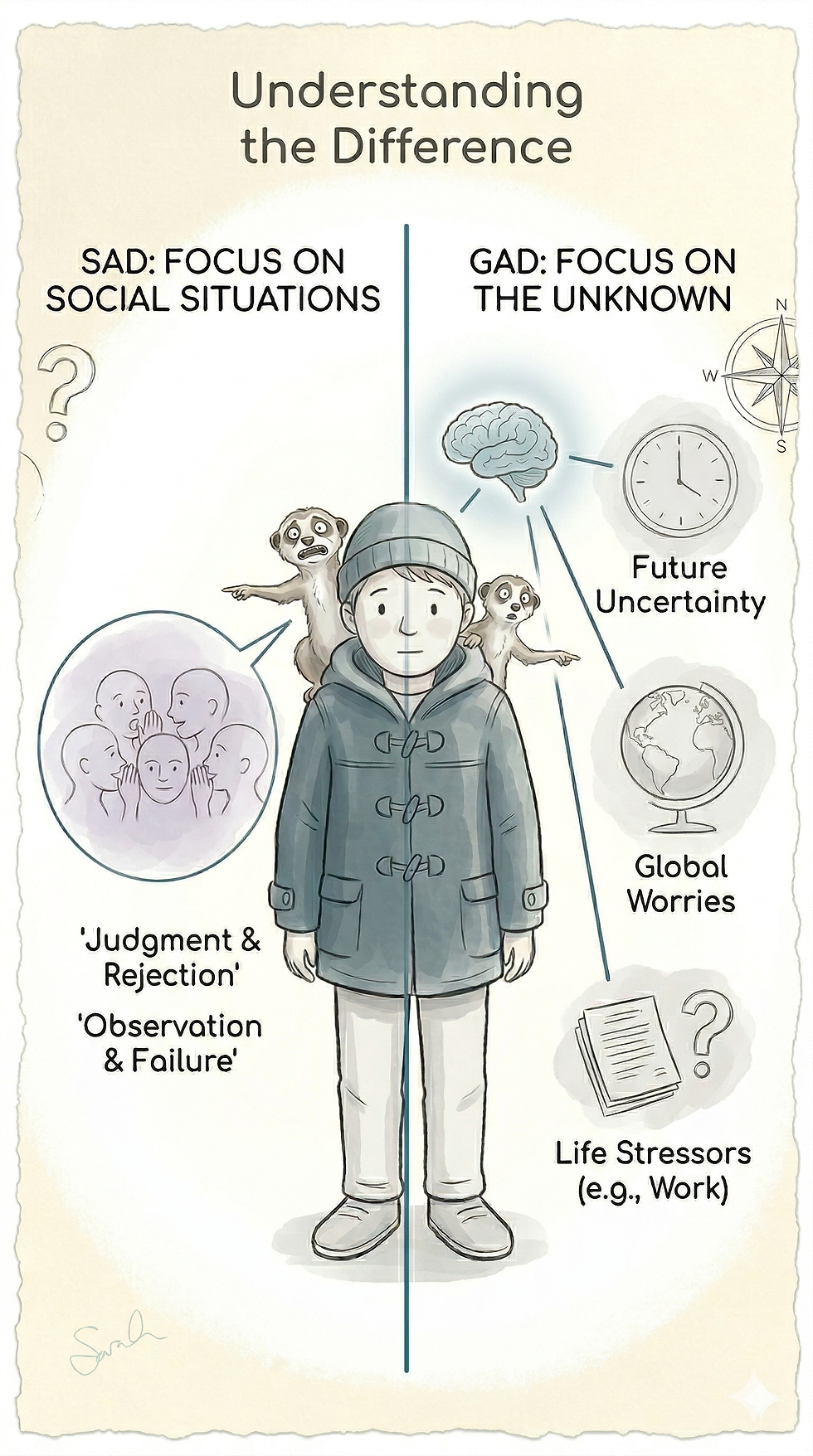
Focus of Thoughts
Social Anxiety:
Generally focuses on social situations - limited or unproblematic worry about other things.
Primarily motivated by a fear of judgment or being rejected by others.
Worry about embarrassing oneself.
Anxiety about being observed.
Fear of showing anxiety symptoms in public.
GAD:
Worries can be topic-based or span general areas; for many, they span general areas.
Worry can attach to the ‘problem at the time’ - for example, the current stressor in one's life - and then move on to the next stressor.
Worries can be future-based on situations that may be unlikely to occur and not related to any specific current trigger.
Trigger Patterns
Social Anxiety:
Triggers are generally always social in nature.
Anxiety generally reduces when alone; however, feelings of loneliness may appear.
GAD:
Multiple triggers across various life domains.
Often present even when alone.
Thought Patterns
Social Anxiety:
Social anxiety-specific thought patterns tend to be directly related to the social situation:
"Everyone is looking at me"
"I'll make a fool of myself"
"They'll notice I'm anxious"
"I'll say something stupid"
GAD:
GAD thought patterns tend to be related to a general fear of the unknown:
"What if something bad happens?"
"Everything could go wrong"
"I need to be prepared for the worst"
"I can't stop worrying"
They Can Overlap
It's possible, and common, to experience both conditions simultaneously.
You can find yourself worrying in social situations (SAD) and about other things (GAD). You can also experience GAD with social worry, but not to the level of SAD.
Treatment Approaches
While there's overlap in treatment approaches, there are some key differences:
Social Anxiety Focus:
Gradual exposure to social situations.
Challenging social beliefs.
External attention training.
Social experiments.
GAD Focus:
Anxiety focus and exposure.
Broader anxiety management tools.
Uncertainty tolerance training.
Problem-solving skills.
However, both can be targeted by evidence-based treatments, including [1]:
Cognitive Behavioural Therapy (CBT)
Acceptance and Commitment Therapy (ACT)
Compassion Focused Therapy (CFT)
Mindfulness practices
Relaxation techniques
Medication (when appropriate)
Lifestyle modifications

Moving Forward
Understanding whether you're experiencing SAD, GAD, or both is crucial for getting the right support.
Remember:
Both conditions are common and treatable.
A mental health professional can help with a proper diagnosis.
Treatment can be tailored to address both conditions if present.
Recovery is possible with the right support and tools!
Remember: While this information can help you understand these conditions better, it's not a replacement for professional diagnosis and treatment. If you're struggling with anxiety, reach out to a mental health professional or your doctor who can provide personalised support and guidance.
About the Author
Sophia Spencer, Specialist Social Anxiety Therapist.
Sophia is a specialist social anxiety therapist, using evidence-based therapy to help socially anxious adults break free from anxiety and find authentic confidence and belonging. She works part-time in the NHS as a CBT psychotherapist, alongside her specialist practice.
You can find more about her here: www.sociallyfearless.com
References
[1] NICE Guidelines 2024, https://www.nice.org.uk/guidance/cg159 and https://www.nice.org.uk/guidance/cg113
[2] Dugas MJ, Gagnon F, Ladouceur R, Freeston MH. Generalized anxiety disorder: a preliminary test of a conceptual model. Behav Res Ther. 1998 Feb;36(2):215-26. doi: 10.1016/s0005-7967(97)00070-3. PMID: 9613027.
[3] Clark, D. M., & Wells, A. (1995). A cognitive model of social phobia. In Social phobia: Diagnosis, assessment and treatment, edited by R. G. Heimberg, M. R. Liebowitz, D. A. Hope, & F. R. Schneier, pp. 69–93. The Guilford Press, New York.

Enjoyed this post and found it helpful? Please spread the word!
Share it with friends, colleagues, or anyone else who might find it valuable. Your support helps grow my community and keeps the conversation going.
Stay in the loop! Sign up for notifications below and never miss a new post.
I respect your inbox—no spam, just fresh content delivered straight to you. Join my community of readers today!


Comments