
3 Essential Breathwork Techniques for Anxiety

Your Toolkit for Calm

Have you ever let out a long, slow sigh?
Not intentionally...just automatically...in a moment of stress or pressure?
Perhaps you were concentrating hard, or feeling the weight of something difficult, and your body just... exhaled.

That sigh wasn't random.
It was your body doing something remarkably clever. It was trying to reset.
And it is the foundation of why breathwork techniques for anxiety are so effective.
When we get caught up in our heads (lost in worry, overwhelmed by pressure, running through a million thoughts), we can lose connection with what's happening in our bodies.
We forget to breathe.
Or rather, our breathing changes without us noticing: it becomes shallower, more rapid, less helpful.
And in those moments, the body's instinct is to intervene with a big, slow sigh (a long breath in followed by an extended breath out) as a way of trying to restore balance.
Understanding that instinct is the key to understanding why breathwork is such a powerful tool for anxiety.
Because once we know what the body is trying to do naturally, we can learn to do it deliberately. We can, quite literally, hack our own biology.
Why Breathing and Anxiety Are So Closely Connected
Breathing exercises are recommended by the NHS for stress, anxiety and panic, and to understand why, we need to go back to our old friend, the inner meerkat.
As I explained in my post on Dropping Anchor, our threat system (the part of the brain responsible for keeping us safe) developed thousands of years ago, when we lived as hunter-gatherers navigating genuinely life-threatening situations.
It operates on a simple "better safe than sorry" principle, and when it detects a threat, it triggers a cascade of physical responses designed to help us survive:
adrenaline and cortisol flood the body,
our heart rate increases, and
our breathing changes.
Specifically, when we feel anxious, our breathing tends to become more rapid and more shallow.
This combination throws off the balance of oxygen and carbon dioxide in the blood, and it's that imbalance, a drop in carbon dioxide levels, that causes many of the most unpleasant physical symptoms of anxiety:
light-headedness
a racing heart
tight chest, and
clammy hands.
The classic signs of the fight or flight response!
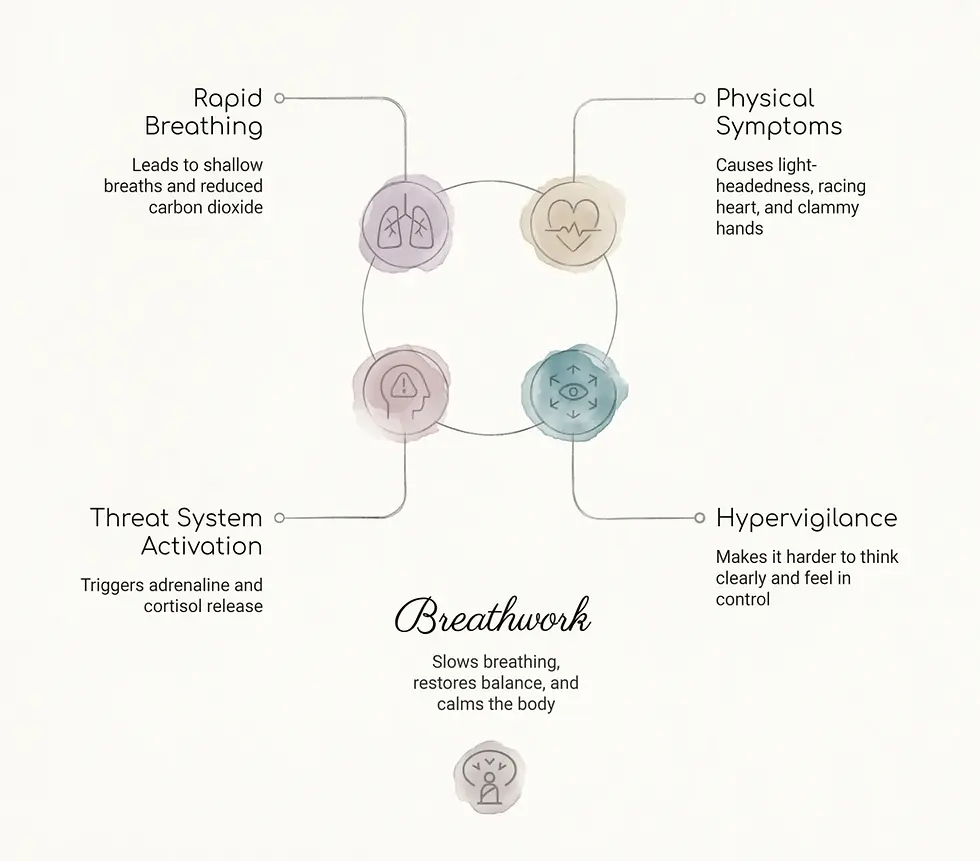
And this is where it becomes a vicious cycle. That rapid, shallow breathing doesn't just cause physical symptoms; it also sends a signal back to the threat system that something is wrong.
The inner meerkat, already on high alert, receives what it reads as confirmation that we are in danger.
It responds by becoming even more hypervigilant, making it harder to think clearly, harder to reason, harder to feel in control.
What we need, urgently, is a way to interrupt that cycle. To send a different signal. To tell the inner meerkat that it can stand down.
That's exactly what breathwork does.
By slowing and deepening our breathing deliberately, we restore the balance of oxygen and carbon dioxide in the blood.

The physical symptoms begin to ease. And crucially, we activate the parasympathetic nervous system (the part of our nervous system responsible for rest and recovery), which begins to calm the body from the inside out.
The adrenaline and cortisol start to reduce. The rational mind gets a little more space to breathe, quite literally, and we start to feel steadier.
We are hacking our biology. And it works!
The Navy SEALs Know What They Are Doing
It's always good to have a number of tools in our anxiety toolkit, and breathwork has been used for centuries across many cultures and traditions: from yoga and meditation to martial arts and performance coaching.
But perhaps the most compelling modern endorsement of breathing techniques comes from what might seem like an unlikely source, the United States Navy SEALs.
Box breathing (one of the techniques we'll be exploring in this post) is taught as standard to Navy SEALs to help them stay calm, focused, and in control in some of the most intensely stressful situations imaginable.
It was popularised in the military context by former SEAL commander Mark Divine as part of the SEALFIT training programme.
But it isn't just elite soldiers who rely on breathing techniques under pressure.
Surgeons use them to maintain focus in the operating theatre. Olympic athletes use them to manage performance anxiety before competition. Paramedics and emergency responders use them to stay calm when lives are on the line. High-performance executives use them to navigate high-stakes decisions.
If it's good enough for Navy SEALs, surgeons and Olympic athletes, it's probably worth five minutes of your time to see what it can do for you.
Breathwork Techniques for Anxiety: Your Toolkit for Calm
There is no one-size-fits-all approach to breathwork. We are all individuals, and what works brilliantly for one person may feel awkward or difficult for another.
The key is to experiment and find what works best for you.
You might be lucky and find that the first technique you try feels immediately natural and helpful. Or you may need to try a few before you settle on your favourite.
Personally, I find traditional box breathing more challenging than door breathing, so door breathing is naturally where I gravitate.
I'm sharing that not to put you off box breathing, but to illustrate that even as a therapist who uses these techniques professionally, it's still a case of finding what fits.
What all three techniques have in common is this: they work.
They calm the nervous system, restore balance to the breath, and create enough space for the rational mind to come back online.
The differences are subtle — in rhythm, in structure, and in how they feel to do. Try them all and see which suits you best.
Technique 1: Box Breathing (4-4-4-4)
Box breathing is probably the most well-known breathing technique for anxiety, and for good reason, as it is an incredibly effective technique for calming the nervous system and relieving stress.

The name comes from the shape: a box has four equal sides, and this technique has four equal counts. Inhale, hold, exhale, hold...each for a count of four.
To help with the rhythm, many people find it helpful to visualise a box and imagine tracing a line around its edges; some people find it beneficial to actually move their eyes to trace the shape.
Each side of the box corresponds to one part of the breath:
Bottom of the box: Inhale slowly through your nose for a count of four
Up the right side: Hold your breath for a count of four
Along the top: Exhale slowly through your mouth for a count of four
Down the left side: Hold for a count of four
- Repeat three or four times
At first, you may find it difficult to find a rhythm with a count of four. If that's the case, try counting to three instead.
With practice, you may be able to slow things down and extend to a count of five or even six.
The longer and slower the breath, the more deeply the nervous system responds.
Technique 2: Door Breathing (6-4-6-4)
Door breathing is a variation of box breathing that some people find easier to settle into.
The holds are slightly shorter relative to the breath, which can feel more natural if the equal counts of traditional box breathing feel difficult to maintain.

The name comes from how you do it: rather than visualising an imaginary box, you can use an actual doorframe in the room to trace around with your eyes.
This has the added benefit of grounding you in your physical environment, because it brings you back into the room, which is calming in itself.
The counts for door breathing are:
Inhale slowly through your nose for a count of six
Hold for a count of four
Exhale slowly through your mouth for a count of six
Hold for a count of four
- Repeat three or four times
Technique 3: Wave Breathing (4-2-6)
Wave breathing is perhaps the most gentle of the three techniques, and the most directly inspired by what the body already knows how to do.
Remember that instinctive sigh we talked about at the start, the body's natural attempt to reset? This technique mirrors that pattern deliberately.
The extended exhale is the key mechanism here.
A longer exhale than inhale directly activates the vagus nerve, which is the main pathway of the parasympathetic nervous system.

In simple terms, the out-breath is where the calm lives. The longer and slower the exhale, the more powerfully it signals to the nervous system that we are safe.
The counts for wave breathing are:
Inhale slowly through your nose for a count of four
Hold for a count of two
Exhale slowly through your mouth for a count of six
No hold, simply let the next inhale begin naturally
- Repeat three or four times
This technique is particularly useful if you find the holds in box breathing or door breathing uncomfortable, or if you are new to breathwork and want somewhere gentle to start.
Which Technique Is Right for Me?
This is one of the most common questions people ask about breathwork, and the honest answer is: it really depends on you!
As a general starting point, I'd suggest trying box breathing first as it's the most widely known technique, and there's a good chance you've heard of it already, which can make it feel less unfamiliar.
If you find the equal counts difficult to maintain, move to door breathing, where the rhythm feels slightly different and having a real doorframe to focus on can be helpful.
If you're completely new to breathwork, or if you find the holds in the other techniques uncomfortable, wave breathing is a lovely, gentle entry point.
Here are a few other things that might guide your choice:
For anxiety and stress in the moment
All three techniques are effective, but box breathing and door breathing are particularly good for creating a strong, structured rhythm that interrupts anxious thinking.
For sleep
Wave breathing, with its extended exhale, is particularly well-suited to helping the body wind down at night. Practising it as part of a bedtime routine can help signal to the nervous system that it is time to rest.
For beginners
Wave breathing has a naturally flowing rhythm, making it a good starting point if breathwork is new to you.
If you have tried breathwork before and found it unhelpful: It may simply be that the technique you tried wasn't the right fit. Try a different one...

A Note on Who Should Take Care with Breathwork
Breathing techniques are safe for the vast majority of people and can be practised independently at home.
However, it is worth knowing that some people may feel slightly lightheaded when they first try these techniques, particularly if they are not used to breathing slowly and deeply.
If this happens, simply return to your normal breathing and take your time.
If you have a respiratory condition such as asthma or COPD, or if you experience significant dizziness, please take these techniques gently and consider speaking with your GP before practising regularly.
As with any self-help tool, these techniques are intended to complement professional support, not to replace it.
The Most Important Thing: Practise Before You Need It
This is something I say consistently across all of the techniques and tools that I share (and I make no apology for repeating it!) because it is genuinely important.
Breathing techniques, like any skill, become more effective the more you practise them.
If you only reach for them in moments of high anxiety, they will feel unfamiliar and less effective, and you may not even think of them at all when you most need them.
The inner meerkat, when it is in full alert mode, is not at its most receptive to new information.
The goal is to practise these techniques regularly when you are calm...when you're making a cup of tea...sitting in the garden...or winding down before bed.
That is how they become second nature.
That is how they become genuinely portable tools you can pull out of your anxiety toolkit whenever you need them.
Even five minutes a day can make a meaningful difference over time.
What happens when you practise breathing exercises every day? The nervous system learns.
It becomes more responsive to the calming signal you are sending it.
With regular practise, you may find that you need fewer repetitions to feel the benefit, and that the sense of calm comes more quickly and more easily.
Ready to Give Them a Try?
I've recorded a short guided audio for each of the three techniques above so that I can walk you through them until you feel confident enough to practise independently.
Find a comfortable seat, press play, and let's breathe together.
The audios are embedded above, next to each technique. Start with whichever one calls to you — or work through all three and see which feels most natural.
If you found these techniques useful, you may also like to try the Dropping Anchor method.
You Have Everything You Need
Anxiety can make it feel like the storm will never pass, and like you have no way of influencing how you feel.
But your breath is always with you.
It is always available.
And with a little practice, it becomes one of the most powerful tools in your anxiety toolkit...something you can use anywhere, any time, without anyone around you even noticing.
The calm is there. Sometimes we just need to breathe our way back to it!
If your inner meerkat has been particularly busy lately and you feel like you could do with some support, please don't struggle on alone.
Reaching out is a sign of strength, not weakness, and a free 15-minute call with me costs nothing but a little courage. I'd love to hear from you.
Keep Breathing.
This article is for general information only and does not constitute medical or therapeutic advice, nor a substitute for assessment by a qualified professional. If you are concerned about your mental or physical health, please consult your GP or a suitably qualified practitioner.
About the author: Sarah Cosway is a BABCP-accredited Cognitive Behavioural Psychotherapist with over a decade of experience working in mental health, both within the NHS and in private practice. She offers tailored CBT in a compassionate, collaborative environment, empowering clients to build resilience and manage their mental well-being with confidence.

Enjoyed this post and found it helpful? Please spread the word!
Share it with friends, colleagues, or anyone else who might find it valuable. Your support helps grow my community and keeps the conversation going.
Stay in the loop! Sign up for notifications below and never miss a new post.
I respect your inbox—no spam, just fresh content delivered straight to you. Join my community of readers today!


Comments